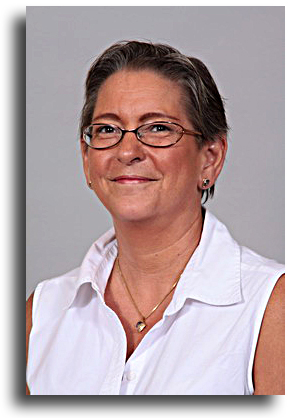
P J Leary
National Psoriasis Foundation Support
Group Leader
Founder of “NCPEAS”
Advocate and Counselor
Founding Member of the E Team
Interviewed by Ed
Dewke
in October 2008
 P
J Leary is one of those people who has lived through the worst
psoriasis has to offer and has turned her experience into a passion
for advocacy. Her “grasp” of
psoriasis is broad both intellectually and experientially. She knows
her stuff — because she's lived it, she's studied it, she's written
about it and she's taught it. She works within all scales:
one-on-one with those she counsels, in small groups as an organizer
and leader, and nationally, as a leader,
spokesperson, teacher, collaborator, advocate and fundraiser. Personally, she
has endured just about every assault psoriasis can make on a human;
she's been through the full litany of treatments, reacted badly to
some, but still looks forward
to new drugs and therapies. She's not an “I-had-that-once” friend of
the afflicted, she is one among the tortured, supporting as many of
us as
she can along the way, but struggling to survive with everybody.
P
J Leary is one of those people who has lived through the worst
psoriasis has to offer and has turned her experience into a passion
for advocacy. Her “grasp” of
psoriasis is broad both intellectually and experientially. She knows
her stuff — because she's lived it, she's studied it, she's written
about it and she's taught it. She works within all scales:
one-on-one with those she counsels, in small groups as an organizer
and leader, and nationally, as a leader,
spokesperson, teacher, collaborator, advocate and fundraiser. Personally, she
has endured just about every assault psoriasis can make on a human;
she's been through the full litany of treatments, reacted badly to
some, but still looks forward
to new drugs and therapies. She's not an “I-had-that-once” friend of
the afflicted, she is one among the tortured, supporting as many of
us as
she can along the way, but struggling to survive with everybody.
I heard about P
J Leary several years ago; finally got to sit down with her at this year's
National Psoriasis Foundation Annual Meeting (August 15-16,
Orlando). The colleague who had recommended P J for a FlakeHQ
Interview
said, “She's working in a kind of quiet task force helping people
with really bad psoriasis....” Sometime later, I heard the
expression “E Team” used in conversation without being defined.
That's about all I knew until this interview. I'm not going to ruin your own discovery of the E Team
other than to say it could mean extreme advocacy. Probably the most potent peer-to-peer
support I've ever heard about. If you are a flaker, and you read
this interview with P J Leary, you will be able to say, “There are
people like me who move mountains.” And you won't be stretching the
truth at all. -Ed
*****
DEWKE: Tell us about your own case of psoriasis.
LEARY:
I first developed psoriasis skin disease when I was 16. It was a severe
guttate presentation that changed to plaque within two months. At that
time I was being seen at Massachusetts General Hospital (MGH) in Boston,
and my BSA [involved Body Surface Area] was determined to be 85%.
In retrospect, it is clear this initial outbreak, as well as many
other subsequent episodes, were most likely due to an undetected strep
infection. The connection between atypical presentations of strep and
guttate presentations wouldn’t be discovered for another 10 years. Over
all, there is no type of psoriasis I haven't enjoyed. Those
include guttate, plaque, inverse, Palmo-plantar pustulosis, and (my
absolute favorite) erythrodermic.
In 1978, during my senior year in High School, I was involved in the
PUVA trials at MGH. It was determined I had a very difficult time
tolerating the psoralin [PUVA = psoralin + UVA light], so I was switched
to UVB therapy after the first month. Unfortunately, I lost about 15
pounds that month, weight I could not afford to lose. The UVB did
curtail the skin symptoms. While I never became clear, I was able to
achieve a thinned out 20% BSA. That same year I was diagnosed with
psoriatic arthritis.
From that time until now, I’ve used the following treatments with
varying degrees of success:
-
Natural
UVB/salt water therapy (while I lived in Hawaii)
-
Clinical
trial with U of Ohio for topical shark cartilage (worked fairly well
except for the months when I got the control medication)
-
Every
topical therapy available, including short contact anthralin
-
Goeckerman regimen
-
Methotrexate, both oral and IM injection
-
Cyclosporine
-
Acupuncture & various diets and supplements (including fish oils and
evening primrose oil)
-
Retinoid
therapy combined with UVB (post child bearing years)
-
Enbrel
(in combination with UVB)
-
Remicade
(at one point in combination with Enbrel & UVB)
-
Humira
(also in combination with cyclosporine recently)
-
Psychotherapy
During my
childbearing years I was very conservative about the treatments I was
willing to try. Since my disease has always been so severe, yet I wanted
to preserve my reproductive health, there were many treatments suggested to me that I would not agree to as a younger woman. For many
years, beginning in 1991 I was an annual patient at the Mary Hitchcock
Clinic at Dartmouth University in Hanover, NH.
Goeckerman
regimen
would clear my skin disease completely as long as I could manage to stay
inpatient for 21 days. That took
exceptional planning and coordination because I was a wife, mother, and
businesswoman. Oh, I forgot to mention I
was on a constant rotation of antibiotic therapy beginning (I think)
around 1987, in addition to whatever psoriasis therapy I was using.
 I remember the first time I was admitted at MHC [Mary Hitchcock Clinic
at Dartmouth]. I had been evaluated, in the typical hospital gown, by a
group of doctors and interns. After I got dressed again, the doctor came in to
see me (my husband was there with me). He asked if I had any idea about
what my current BSA was, and I said I thought about 80%. I recall
he shook his head sadly, and quietly informed us they had
determined I was at 99%.
I remember the first time I was admitted at MHC [Mary Hitchcock Clinic
at Dartmouth]. I had been evaluated, in the typical hospital gown, by a
group of doctors and interns. After I got dressed again, the doctor came in to
see me (my husband was there with me). He asked if I had any idea about
what my current BSA was, and I said I thought about 80%. I recall
he shook his head sadly, and quietly informed us they had
determined I was at 99%.
I was the last patient ever treated at that clinic when, in the late
'90's, insurance companies had determined severe psoriasis did not
warrant inpatient treatment. While my dermatologist wanted me to be
treated inpatient for 21 days, my insurance company reluctantly agreed
to pay for 4 days.
In 1990, my dermatologist suggested I get a home UVB unit, and
wrote a prescription for one. My insurance company denied. For an entire
year I drove 30 miles each way, 5 days a week, to get UVB treatment in
his office. At the end of that year, my dermatologist wrote a lovely
thank you note to the administrators of my health insurance plan,
informing them of how much his practice had billed for my UVB treatments
that year and mentioning the cost of the unit he had suggested. The
following week, a UVB unit was delivered to my home, co-payment waived.
More recently, my worst erythrodermic flare occurred in May of 2003. At
that time, I had visiting nurses in my home twice daily to assist me
with everything from bathing to medications to eating. They were here
for 3 months. I was blessed to have my community come to help my family
during all of that. They cooked, cleaned, and drove my children to
activities.
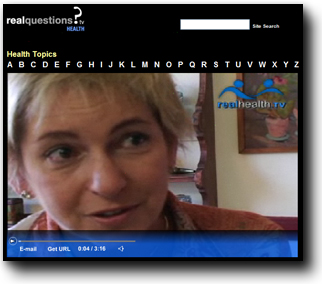 [Please take a moment to
watch this short video.
(High speed Internet connection recommended.) –Ed]
[Please take a moment to
watch this short video.
(High speed Internet connection recommended.) –Ed]
As I stated in this video, I decided it was time to consider some
potentially riskier medications. I was aware of the first TNF-a
medications, but there had been, as you may recall, a waiting list for
those folks who were self pay. No insurance companies would cover them
for several years. Enbrel (etanercept) was so successful in managing
both psoriasis and psoriatic arthritis, Amgen (based in MA), had to
raise capital in order to expand sufficiently to meet patient demand.
In August, 2003 I began using Enbrel. I found it was amazing for
controlling the symptoms of the PA, less so for the skin disease.
However, I did see about a 75% improvement in my
PASI score.
Then again, it is important to know my fabulous research Doc at
Duke likes to say, “PJ, you are not exactly a stable psoriasis patient.”
That fact gets me treatment from the best and smartest, but my disease
is in fact very severe and unpredictable. In any case, I used Enbrel
until it stopped working entirely at the 18 month mark.
Because I believe in patient driven care, my next choice was Remicade. I
combined the loading dose with UVB and found myself completely free of
skin disease, with the arthritis well managed after 5 months of
treatment. I remained that way for 24 months. At the time, I saw
diminishing results, even after adjusting the dose. Then, a really bad
thing happened. During my regular infusion this past January, I
contracted a cellulitis infection. That infection had doctors discussing
the potential amputation of my right arm, and had me in the hospital 5
times between the initial episode and April.
It was determined the Remicade was a catalyst for the recurring cellulitis infection, so I stopped that therapy. The only other biologic
available to treat both diseases was, of course, Humira. I began
treatment in July and it seemed during the loading dose phase that it
would be very helpful. However, it has not worked well for me. After
[the National Psoriasis Foundation 2008 Annual Meeting] in August, I returned home and found myself fighting off an
impending erythrodermic flare. My fabulous doctor at Duke and I decided
to add 300 mg of cyclosporine to the mix for 45 days. It did the job of
reducing the inflammation and the very painful Palmo-plantar pustulosis, but once again I
lost about 5 pounds. Cyclosporine makes me feel very ill and I have a
hard time holding down food. It also causes a sharp increase in my blood
pressure, which is worrisome.
I have an
understanding with my fabulous Duke doctor that I will be in his office
the day after CNTO-1275 [maker Centocor, Inc.] is approved, No
appointment required, Mrs. Leary. I have now had psoriasis for 32
years.
DEWKE: Do you have a lot of family history with psoriasis?
LEARY:
My father has a strong family history of psoriasis. Dad's grandmother
and father both had severe disease, as do he and I. My mother had a case
of what she described as “sympathetic psoriasis.” In fact, she had mild
disease, elbows, knees, and scalp.
I have three siblings, and only one has psoriasis. My brother has had
psoriatic arthritis since he was about 20, and mild Palmo-plantar
pustulosis (feet only).
Unfortunately for my own family, my husband developed very mild
psoriasis a couple of years ago. We have two children together, so the
risk factors increased. Of my four children (the older two only have one
parent with disease, me) three have had episodic strep induced guttate
flares. One had her first issue at 8, one in her early teens, and one as
an adult. Fortunately, we know to treat the asymptomatic strep
immediately, and they have never required any treatment other than mild
topicals and antibiotics.
So far both of my grandchildren have been free of psoriasis.
DEWKE: Returning to the
treatments you've tried, for a moment: You've personally experienced a
lot of drug-related “adverse events,” haven't you?
LEARY: Psoralin makes me vomit uncontrollably. I actually had a
doctor tell me once when I was in my 30's that I really did not want to
have success with treatment when I refused UVA therapy and insisted on
UVB.
Methotrexate makes my cholesterol go over 1000, gives me migraines, and
makes me vomit. (I have perfected the system of taking a Compazine
suppository, then eating, then trying to nap all the while hoping I
won't awaken while vomiting.)
Many UVB burns until I learned to set the machines myself.
Cyclosporine is no better than methotrexate for side effects.
Then there is the part about trying not to die or lose important body
parts. (See above concerning erythrodermia and my battle this year with
cellulitis.)
Unlike many psoriasis patients, I am constantly working on
gaining/maintaining weight. Today I am 10 pounds lighter than my target
weight. Since my immune system is so compromised, this is a serious
issue for me in the event I catch a cold or the flu.
DEWKE:
You are a
well-known advocate in North Carolina and the rest of the country. How
did you initially get involved?
 LEARY: It
all began at the Hitchcock Clinic at Dartmouth decades ago. A boy aged
11 was admitted to the clinic; both he and his parents were frightened
to death. His parents had done their research and learned the Clinic
experience was the best treatment choice available at that time. The parents were well
educated, but did a basic “dump and run” with their son. The parents
were obviously put off by the patients walking around “in tar.”
LEARY: It
all began at the Hitchcock Clinic at Dartmouth decades ago. A boy aged
11 was admitted to the clinic; both he and his parents were frightened
to death. His parents had done their research and learned the Clinic
experience was the best treatment choice available at that time. The parents were well
educated, but did a basic “dump and run” with their son. The parents
were obviously put off by the patients walking around “in tar.”
The Doc asked
me if I would be willing to try to talk to this boy. I was the only
mother female in the clinic at the time who was of the appropriate age
to perhaps be his parent. I was barely 30 then. It took several days to get him to
talk, but eventually he did. That experience got me thinking about the
many plights of the patient community.
When I
arrived home from that very treatment, I saw a
young dermatologist who asked for my opinion on the program at
Dartmouth. I mentioned to him that I had encountered an elderly lady
who had only negative experiences to share about her time there. He told
me that when folks are diagnosed with a chronic disease like severe psoriasis
that is so painful, they take one of two approaches. They either become
insular and bitter, or they become the very finest version of
themselves.
Those events, with the boy and the young dermatologist caused
me to define how I wanted to serve this patient community.
I was raised
to feel an obligation to give my time and resources to the community.
With the psoriasis patient community, I had something helpful to
contribute.
DEWKE: You use the expression
“plights of the patient community.” What do you think are the most
important plights our community faces these days?
LEARY: I
would say there are three issues I hear about from the patient community
both here in North Carolina and on a national level. They are as
follows:
a. Access to care, including how to pay for medicine that works
b. Discrimination both in the workplace and the community (e.g., the
pool)
c. Access to services, which might fall under self-esteem to some extent.
Consuming personal services, like manicures and haircuts, is stressful.
DEWKE:
I think it would be fair to
call you an “advocate's advocate.” You've been at this long enough, and
been successful enough, for others interested in becoming involved to
look to you for leadership and direction. What are some of the ways the
rest of us can get started?
LEARY: I think the best way others can get involved to begin
with would be by participating on the
National Psoriasis Foundation
message board forums and connecting
with other leaders through those forums. I would also suggest talking with
staff at the Foundation about what exactly one might be able to do.
There are many opportunities. Taking on the opportunity to do some
medical or political outreach is a wonderful way to begin to make
headway in any community. I would also like to mention that I make
myself available for one on one consultation all the time. I can't tell
you how often I hear from folks that they don't want to “bother me.”
Please know that I want to be bothered. All I ask is that we make an
appointment for our conversation.
DEWKE: Do you think our current health care business in the United
States is “flaker friendly?” If not, what do you think needs to
happen and how can we work to make it happen?
 LEARY:
Health
care and psoriasis, loaded question there, Ed.
I can tell you what my groups and I are doing. We understand that this
is a time of potentially huge change in how health care is administered
in our country. As a result, here in Raleigh, we have a big meeting
planned for the Monday after the national election where we'll be
talking about these issues with our local politicians. I know access to care has been the most important issue in our patient
community for many years, and I have been pleased to be involved in
making changes in our favor. I think the jury is out on this issue until
we know which party will be leading our country.
LEARY:
Health
care and psoriasis, loaded question there, Ed.
I can tell you what my groups and I are doing. We understand that this
is a time of potentially huge change in how health care is administered
in our country. As a result, here in Raleigh, we have a big meeting
planned for the Monday after the national election where we'll be
talking about these issues with our local politicians. I know access to care has been the most important issue in our patient
community for many years, and I have been pleased to be involved in
making changes in our favor. I think the jury is out on this issue until
we know which party will be leading our country.
To answer the question, though, I know for a fact our current
system is not at all friendly to psoriasis patients. I can't tell you
how many times I have fought with insurers for appropriate care for
myself and for others. I recall the last time I went to Dartmouth: my insurance company pre-approved the admittance. Then the day I
was scheduled to go, they pulled the approval. They said I should
seek specialized nursing assistance closer to home (I was in Southern
Maine then). I said “Fine, please tell me where to go.” I already knew
there were no derm beds in Boston. They got back to me later that day to
let me know they were still going to deny even though they couldn't find
any derm beds closer than Hanover.
Understanding the process, I asked for a medical review. I was well
aware this meant my insurance company was required to convene a
panel of specialists, in this case dermatologists, to make a
recommendation. I also knew the providers were mad and frustrated
with the cuts on care for their severe psoriasis patients; cuts
everywhere, from UV therapy to inpatient care. Of course, the
panel determined a patient with unstable disease and 90% BSA should
be treated inpatient. The following day, I drove to Hanover, a
four hour trip for me. By the time I got there, the insurance company
had decided to pull the approval once again! I got on the phone, but was
only able to get approval for 4 days.
DEWKE: At FlakeHQ we've heard from quite a few parents of
“P-kids.” Obviously, the relationship between parent and child is
always individual and unique, but what general guidance do you give when
parents who are not psoriatic find out they have a child who is?
LEARY:
The very first “other message board” that was created
when the National Psoriasis Foundation was young on line was the “Family and Caregivers” board. I had been the
administrator of the Psoriasis Board at Parent's Place.com for
several years, and when the National Psoriasis Foundation got on line, I
brought my members there. I have been a firm and vocal advocate for our
youth for a long time. As a parent with three children experiencing
psoriatic disease issues, I understood the issues faced by families. I
am proud to say this year Raleigh held the first Family & Children Support Group event in the
country.
That meeting was held in September. We did a big presentation at my favorite spot, the Hilton,
complete with unique slideshows and a nice luncheon. We had the “kids”
in with the adults for the beginning of the meeting, then I split them
out to a room next door with our Youth Leader. They joined us an hour
later for lunch, then broke out again. At the end of the meeting, I had
a mother approach me obviously wanting the opportunity to chat. I swear
to you that this woman stood in front of me, and as she began to speak,
she burst into tears. I gently led her out into the hallway and offered
her a hug and a tissue.
This woman said that she was so grateful for the opportunity to learn
more, from a reliable source, about the disease her son suffers so
terribly. She had become frustrated trying to get him the appropriate
medical help. However, she did have an appointment for him at Duke the
following week with our fab Doctor M, and she felt prepared to make good
choices after listening to our presentations and talking with other
patients and parents.
Here in North Carolina, as advocates, we have been working with families
throughout the country for many years. We have the only
Foundation-trained youth leader in the country. We have a well
established method of helping these families, and our tracking records
are impressive. My daughter Deirdre was responsible for the majority of
the program for Youth at the 2008 National Psoriasis Foundation Annual
meeting this year. She did a phenomenal job. That was her own work, I
had no involvement, and it was rated as exceptional.
At the end of one
day at the Foundation’s Annual Meeting this year, both Deirdre and I had
made presentations, ones we were both a bit nervous about.
Both were received very well. We had a Mom/daughter moment sitting
outside (so I could smoke). What my daughter said to me that caught my
heart was this: “Mom, it was better than I had imagined, but what is
really exciting to me is now I know exactly how I want to do this
in North Carolina!”
I cannot over-emphasize how important it is to appreciate psoriasis as a
family issue. And I don’t mean just among those of us in families with
numbers of individuals who have the disease. It’s just as much a family
issue when only one has the disease, though the experience and issues
may be different.
DEWKE: What are your current goals in advocacy?
 LEARY: We have come far as a patient community in the thirty-plus
years I have been a patient. Certainly one of the most important
changes has been the advent of biologics. However, we have also
benefited greatly from the communication the Internet and World
Wide Web provides. While I have enjoyed the opportunity to expand
services in my home state of North Carolina, I have also been able to do
so nationally by working with the National Psoriasis Foundation.
LEARY: We have come far as a patient community in the thirty-plus
years I have been a patient. Certainly one of the most important
changes has been the advent of biologics. However, we have also
benefited greatly from the communication the Internet and World
Wide Web provides. While I have enjoyed the opportunity to expand
services in my home state of North Carolina, I have also been able to do
so nationally by working with the National Psoriasis Foundation.
My goals today are very different than they were just a few years ago.
This is such an important time for our community to have a voice in
health care reform, and I plan to be right there. I don't ever want my
children or grandchildren to have the painful experiences I have endured
in my life. I want them to have more choices, and I want them to walk in
a world that is kind to people with any type of disability.
I believe these goals can be accomplished in several ways, but the very
first is for patients to stop hiding, to be willing to come forward and
tell their stories in compelling ways. I actually attended a seminar on
how to effectively share your story at the National Psoriasis Foundation
annual meeting in 2006. Telling my own story is an issue with which I have struggled for many
years.
Although I stated that at the beginning of the session, nobody took me
at my word because I had just been given the
Volunteer of the Year
award at
lunch. As a part of the workshop, we were all to consider how we might
share our personal stories, and told we would be required to do so in
that session. I suppose because I'd already been up there, accepting my
award, it was decided I should go first. The humiliating
truth is when they pressed, I cried, in front of everyone in that
room. I couldn't do it then.
 However, I decided that I was going to work really hard on developing
that skill, and I think I have made some progress. We all need
to be able to do this, maybe not on TV or the web, but beginning with
our families, friends, and co-workers. I can say it gets easier
with time and practice.
However, I decided that I was going to work really hard on developing
that skill, and I think I have made some progress. We all need
to be able to do this, maybe not on TV or the web, but beginning with
our families, friends, and co-workers. I can say it gets easier
with time and practice.
DEWKE:
I’ve saved this one for last. I know you are associated with something
called “the E Team.” Would you be willing to share that story with us?
LEARY: The E
Team is a group of dedicated patient advocates from around the country
who counsel patients with
erythrodermic psoriasis.
Most of the deaths in the U.S. associated with psoriasis
involve an erythrodermic patient.
When these patients started showing up on the Foundation’s message
board, Mike Kammer came up with the idea of pairing each one with an
advocate. The requirement for being an advocate on this team is having
survived an erythrodermic event. As you know, there is no substitute for
personal experience when talking with patients. I was the first
advocate.
Now we have six advocates on the team. Three years ago, the Medical
Board at the Foundation decided to make us an official project
under the umbrella of the Foundation. At the time, we were working on
developing a list of dermatologists trained to treat this severe form of
psoriasis. It has been our practice to refer these patients to a medical
provider as close to their home as possible. Since we counsel folks from
all over the country, this is a huge task. As you might imagine, it is
very important to get these folks in to see qualified providers
a.s.a.p., and our doctors accept these patients within 24 hours of our
referral.
This is a very uncommon way of doing advocacy. It is almost unheard of
in the medical community. How often do the best and brightest doctors accept
immediately a referral from a lay advocate? The first doctors to sign on
to the national list were all of the members of the
Medical Board
of the National Psoriasis Foundation. In order to make this happen, Gail Zimmerman
[then CEO of the Foundation] asked me to write the project brief, which went first to the
Board of
Trustees and then to the Medical Board.
Mike Kammer is generally in charge of identifying these folks, and also for
determining which advocate might be the best fit. However, there are
times when each of us has had as many as three patients at a time. The level
of commitment from this team is incredible. Each patient requires
something around 25 hours of service from intake to resolution. The
good news is that a few of them decided, after getting such
extraordinary advocacy assistance, to join us. Some have even become
Support Group Leaders.
Not all of the patients we ask agree to join us in a formal manner, it
is a big commitment. Generally, a new advocate spends several months
reading and watching and learning. We share information about each
client (with their permission) in case the advocate they have been
working with becomes unavailable for any reason. Then someone else can
pick up and go forward without having to go through the whole intake
process again.
While Mike Kammer gets full credit for creating the team, I created the methods
we use in the actual counseling. Having so much experience with
erythrodermic psoriasis, earlier this year Mike and I were both asked to
provide feedback for the Foundation's new publication for Emergency
doctors on the diagnosis and appropriate treatment of erythrodermia. I
was astounded to see that the original document did not contain any
suggestions for pain or itch, and made the appropriate suggestions. At
this time, that document is sitting with the Medical Board for their
additions and approval.
In the early years, the Team was not well known. However, as we
counseled more and more patients, it came to be known in the online
patient community that we were doing something good, and we began
getting emails and personal messages from experienced posters when a potentially
erythrodermic patient was posting. A couple of years after we became an
official Foundation program, Mike and I did a presentation to the
Support Group Leaders about the project. There had been a
misunderstanding from newer staff about our roles as advocates and it
was necessary to explain the program to staff and leaders. You see,
since this work goes on long distance, by phone, we always ask that the
client call the Foundation to confirm our references as advocates. While
we don’t insist on that with adult clients, we won't even talk with a
parent until we can confirm that they have made the call.
DEWKE:
Thanks so much, P J, for taking the time for this interview. I actually
feel like I've stolen time from the many important things you would
otherwise be doing for me and everyone else with psoriasis! You have
expanded our vision of psoriasis advocacy and blazed a path that beckons
all of us.
#####
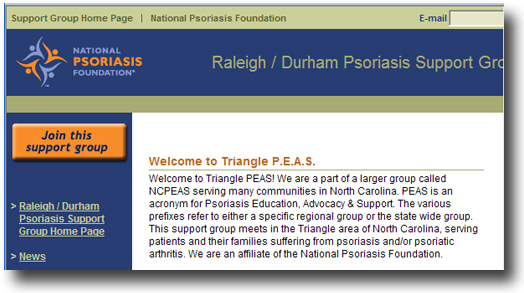
Visit NC PEAS web page
here:
http://support.psoriasis.org/raleigh/
FlakeHQ
Interviews Home
www.flakehq.com
 Nov-Dec '08 |
briefing |
mail | interviews
| articles |
psorchat
|
don't
say this |
flaker
creativity | flakers' jargon |
other
places | archives | send
mail | ed dewke | search |
acknowledgments
| legal
stuff
| Flake: Confessions of a Psoriatic
| ©2008 Ed
Dewke
Nov-Dec '08 |
briefing |
mail | interviews
| articles |
psorchat
|
don't
say this |
flaker
creativity | flakers' jargon |
other
places | archives | send
mail | ed dewke | search |
acknowledgments
| legal
stuff
| Flake: Confessions of a Psoriatic
| ©2008 Ed
Dewke