 Sep-Oct '10 |
briefing |
mail | interviews
| articles |
psorchat
| don't
say this |
flaker
creativity | flakers' jargon |
spouses corner |
other
places | archives | send
mail | ed dewke | search |
acknowledgments
| legal
stuff
|
Flake: Confessions
of a Psoriatic
| ©2010
FlakeHQ, Inc. Sep-Oct '10 |
briefing |
mail | interviews
| articles |
psorchat
| don't
say this |
flaker
creativity | flakers' jargon |
spouses corner |
other
places | archives | send
mail | ed dewke | search |
acknowledgments
| legal
stuff
|
Flake: Confessions
of a Psoriatic
| ©2010
FlakeHQ, Inc. |
|
New Supervisor Too
Inquisitive? I started a new job a few months ago when my skin was pretty clear. In fact, my psoriasis wasn’t visible at all. About six week into the job I had a flare-up involving both my hands and my face and scalp. Staff just getting to know me reacted as you might expect. Some pretended not to notice, which meant they were always looking away when they talked to me. Others frowned, made comments like “Do you want to borrow some lotion, Lilly?” without really needing or wanting an answer or an explanation. A few really were curious and to them I gave the line we all use: “Psoriasis ... chronic ... non-contagious ... comes and goes....” I got most of the expected responses, too, “I have an aunt with that... It’s tough... So sorry... Have you tried ____?” All of that is par for the course. What REALLY got my goat, though, was my immediate supervisor. She noticed but said nothing for about a week. Finally she called me into her office and said, “Did you mention anything about your skin problem on your employment application?” I was shocked, didn’t know what to say. I finally blurted that there was no reason to mention it as it required no special accommodation and wasn’t contagious. Then she got sympathetic and wanted to know if it hurt and if it would ever get so bad I’d have to take sick leave, and how often did I have to go to the doctor. All the while I was wondering if she really had to know all this and if it was even LEGAL for her to be asking for all this information. My supervisor wasn’t unkind or threatening and I still don’t quite understand what all the questions were about. I haven’t been fired and my psoriasis has since stopped being a subject of conversation. I just thought my experience was worth sharing. Perhaps there are legal limits to what can be asked? -Lilly S. *****
I’m not a HIPPA expert, so won’t try to give you a legal opinion on what can be asked and/or must be disclosed. My own belief, though, is that health information is private and I wouldn’t feel compelled to give out my own information if I didn’t feel comfortable doing so. It seems to me you answered the salient question right up front: My psoriasis “requires no special accommodation and isn’t contagious.” Your supervisor’s questions about possible absences as a result of your condition may or may not have been appropriate. Of course, typically psoriasis does not require inordinate absences from a regular job, extreme cases notwithstanding, so your honesty in responding would probably not have had any adverse consequences. Some jobs can’t be fulfilled without dependable attendance. Employee agreements, in these cases, should contain language making policy explicit. For example, number of “sick days” allowed per year ... number of uncovered (non-paid) days absent before termination ... retention policy regarding short and long term disability conditions — these situations should be addressed in the Employee’s Manual or a similar document. The “rules” as set forth in these employment documents should apply and trump any other consideration based on informal “guesses” about how many days you might be sick. At least, that’s how I feel. If other readers have more informed information, I hope they’ll share with us. Thanks for sharing your story, Lilly, and I hope you enjoy your new job as much as I’m hoping to enjoy mine! -Edwww.flakehq.com |
 Ed’s
Response: First, Lilly, let me apologize for the delay in responding.
I’ve been in the process of getting a new job, too, and wanted to let
you know how my own “disclosure” went. As I’ve been on Humira for about
five years, now, my psoriasis is clear except for one lesion on my right
calf and some scalp lesions that aren’t visible if I don’t scratch. It
could have been a secret for quite a while, I suppose. However, the job
I was applying for (and subsequently got hired for) involves web
management and I wanted to use FlakeHQ.com as one of my examples. I knew
there would be questions about the site. Those questions finally came up
in what I refer to as a “gang interview” and, to make my explanation of
what psoriasis IS more obvious, I jumped out of my seat, raised my pant
leg and showed the “gang” (all guys, in case that matters). It put any
further questions about what psoriasis “is” to rest. The picture here
(which is a mirror image of my right leg, so it looks like my left leg
to you) is
close to what they saw, but I was wearing a shoe and sock to the
interview (duh!).
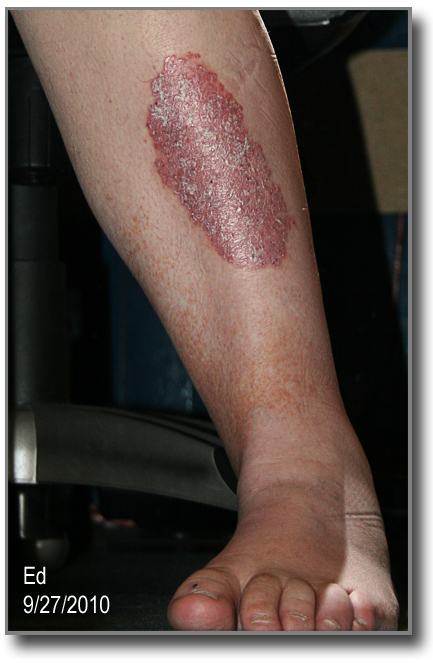
Ed’s
Response: First, Lilly, let me apologize for the delay in responding.
I’ve been in the process of getting a new job, too, and wanted to let
you know how my own “disclosure” went. As I’ve been on Humira for about
five years, now, my psoriasis is clear except for one lesion on my right
calf and some scalp lesions that aren’t visible if I don’t scratch. It
could have been a secret for quite a while, I suppose. However, the job
I was applying for (and subsequently got hired for) involves web
management and I wanted to use FlakeHQ.com as one of my examples. I knew
there would be questions about the site. Those questions finally came up
in what I refer to as a “gang interview” and, to make my explanation of
what psoriasis IS more obvious, I jumped out of my seat, raised my pant
leg and showed the “gang” (all guys, in case that matters). It put any
further questions about what psoriasis “is” to rest. The picture here
(which is a mirror image of my right leg, so it looks like my left leg
to you) is
close to what they saw, but I was wearing a shoe and sock to the
interview (duh!).