Sep-Oct
'05 |
briefing |
mail | interviews
| articles |
psorchat
| psorchat review |
don't
say this |
flaker
creativity | flakers' jargon |
other
places | archives | send
mail | ed dewke | search |
acknowledgments
| legal
stuff
| ©2005 Ed
Dewke Sep-Oct
'05 |
briefing |
mail | interviews
| articles |
psorchat
| psorchat review |
don't
say this |
flaker
creativity | flakers' jargon |
other
places | archives | send
mail | ed dewke | search |
acknowledgments
| legal
stuff
| ©2005 Ed
Dewke
|
|||||||
FlakeHQ
Interviews:
Dr. John O.A. PaganoChiropractic Physician Interviewed
by Ed Dewke
***** ED: You have written that you found, in the works of Edgar Cayce, what sounded like a logical explanation for psoriasis. In his writings, Cayce went on to suggest a remedy and you have written that you spent 15 years in concentrated research, after which you concluded Cayce was mostly correct. What drew you to the works of Edgar Cayce in the first place? Pagano: My interest in the Edgar Cayce works began by reading a newspaper article in the Indianapolis Star while I was still a student in chiropractic college almost fifty years ago. Being interested in the healing arts, I found his work fascinating to say the least, especially since he seemed to have had answers to questions that perplexed medical science at the time. I became a member of the Association for Research and Enlightenment (ARE) which had been originated in 1931 by Cayce and his followers in Virginia Beach, Virginia. The ARE provided me with monthly bulletins called “The Searchlight” that contained articles on the Cayce principles of health and disease. Since most of them dealt with a “natural” approach to healing, I felt a rapport with the work and continued my studies.
ED: The fundament of your regimen is the assertion that toxic substances leaking from the intestines cause psoriasis lesions in the skin (because these toxins are carried there by blood and lymph). Is this theory totally different from the medical establishment theory that psoriasis is an autoimmune disorder? Or can the two be related? Pagano: The two can be related. The trouble with the medical approach is that they don't go back far enough. It is my contention that the immune system does in fact have a disorder: the toxic buildup within the body because of the intestinal permeability (leaky gut) slowly but surely breaks down the immune system. The most recent medical concept is that the lesions present in psoriasis are due to what they call the T-cell theory. Because they have found numerous T-cells present at the site of lesions, they conclude that the T-cells are the cause of the disease. Therefore the theory is: destroy the T-cells and you destroy the psoriatic lesions. I take exception to this. The T-cells are known to be the first line of defense of the human body against the external environment. For what it is worth, I look upon the T-cell accumulation as an effect of the lesions, not the cause. The lesions are formed as a result of the body discharging the toxic buildup that takes place due to the internal pollution. According to Cayce, this discharge takes place through the sweat glands (Cayce reading #3373-1). In my opinion, the T-cells act as a barrier at the site of the lesions in an attempt to protect the patient from adverse external influences.
ED: Why do you think the biologic drugs Enbrel and Raptiva (in particular) are clearing some patients by inhibiting very specific T-cell functions? Pagano: The jury is still out — as far as I am concerned — on the overall effect Enbrel and Raptiva have on the human organism. They claim these drugs seek and destroy the T-cells, which may or may not be the case, but I am not qualified to judge on such matters. But if history repeats itself, new drugs will come down the pike to replace the old. If people want to use the biologics and have the means to do it, then they should follow the advice of their dermatologists. With some people, especially those who have difficulty in disciplining themselves, it may be the only way to go. But for how long and at what price? Sad, is the way I see it. If they only knew the answer to their problems may very well be found in the cupboards of their own kitchen!
ED: If I've read your book correctly, the diet — which is arguably the best known part of your regimen — is primarily intended to keep toxins out of the intestines. Most of the other elements of your regimen are intended to heal the damage already caused. If this is correct, what advise do you share with people who want only to try the diet? Will they be successful?
ED: Is it safe to say, then, that the other "ingredients" in your regimen — teas, spinal adjustments, colon cleanings, topical applications, meditation and right thinking — are processes intended to SPEED healing? Pagano: Absolutely!
ED: A study of five patients across six months conducted at the Meridian Institute, Virginia Beach, Virginia, provides some persuasive evidence about the effectiveness of your regimen. (Here is a link [active as of 7/25/2005] to an article about this study titled, “Medical nutrition therapy as a potential complementary treatment for psoriasis — five case reports.”) Here is what the research report says about intestinal permeability in the test subjects (a.k.a. "leaky gut"): In all five cases in this study, intestinal permeability improved during the course of treatment according to the lactulose/mannitol test.... However, interpretation of the role of permeability is complicated by the fact that in only two cases was initial permeability outside the norms provided by the testing laboratory. It is possible the dietary regimen employed in this study reduced intestinal permeability to previously present dietary compounds, despite the fact permeability was in the normal range in several cases. How would you interpret this conclusion? Put another way, how would you explain the success of your prescribed diet in cases where intestinal permeability may not be a problem? (Or, is the real problem associated with how we measure intestinal permeability?)
Pagano: I look upon the leaky gut concept as a cause of psoriasis, as a reasonable theory to go on, and the most plausible. One thing is certain in my estimation: the focal point of the origin of psoriasis, eczema, and related diseases lies in the condition of the intestinal tract. A very common cause of the intestinal disorder is intestinal permeability (or a leaky gut). The reason why a person may have an intestinal wall that falls within the normal range in the lactulose/mannitol test is one of those problems that perplex the researcher. For instance, a patient may be riddled with psoriasis on every square inch of his body and yet have a perfectly normal blood picture and urinalysis. This is generally the rule rather than the exception. I still hold to the theory in general. At least it is something to go on (notwithstanding the T-cell theory) that sounds logical and without any harmful effects from the regimen suggested. I follow this theory, and it works on many, many cases. Lets
keep in mind that the results obtained on any given research
project is what confirms or denies the value of the approach taken, not
the evaluation of numbers. The patients themselves constitute the best
test tube — or to put it more succinctly, “the proof is in the pudding.”
ED: Earlier you mentioned the importance of proper elimination to the success of your regimen in healing psoriasis. In your book (HEALING PSORIASIS...) you describe “normal bowel movements” as at least once or twice — or more often — daily, and you associate less frequent bowel movements with psoriasis. What if proper elimination, by your definition, is not an initial problem? I can legitimately use myself as an example, here. My psoriasis is diagnosed as chronic and severe, yet twice-a-day bowel movements (usually more) are my norm and have been for as long as I've had psoriasis (15 years). Pagano: It is, and has always been, my contention that in cases of psoriasis (as well as eczema) the skin is doing what the bowels and kidneys should be doing. In other words, the toxic accumulation is taking place faster than it can be eliminated by the normal emunctory channels. Now in a case such as yourself, where there seems to be no elimination problem, I can only deduce that the problem still lies in your dietary habits and/or your emotional makeup. Mind you, there are several causes listed as culprits in breaking down the intestinal walls, i.e. parasites, viruses, hyperacidity, excessive use of antibiotics, etc. Normally the bowels should eliminate waste material one to three times a day. But if the initial irritant has not been dealt with, whether physical or emotional, the problem will remain.
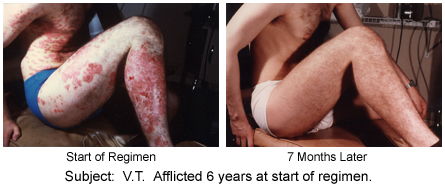
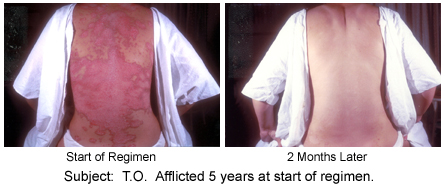
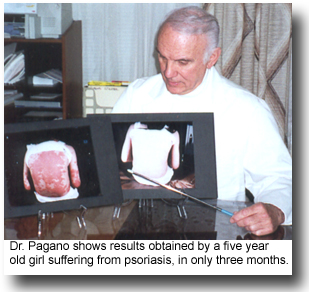
ED: TIME is a critical factor in your regimen. You promise no “quick fixes.” But how much time is reasonably required to determine if the regimen is working? Obviously, if the diet could be easily adhered to and adopted forever, an improvement in ones psoriasis in a year, or even two years, may be satisfactory. But for those who find the diet constitutes significant life changes, and who have the means to find help in traditional medical treatments, what is a reasonable trial period for your regimen? (What might be some early indications that the regimen is working, even before psoriasis lesions improve?) Pagano: Based on my years of experience in dealing with psoriasis, a reasonable time period for observing substantial results is anywhere from three to six months. That is the average on this regimen. Of course there are exceptions. My fastest responding severe case was thirty days, after a 60-year old man had suffered for thirty years! The longest period of time with a patient was two years, after having been treated by one of the most prestigious university hospitals in the country for 28 years! Both these cases represent extremes, but the average is 3 to 6 months. There are three responses that occur during the healing period that indicate the regimen is working, and they occur generally in this order: 1) less itching, 2) less scaling, and 3) a general sense of well-being. But let us not forget that the determinative factor is and always has been the faithfulness of the patient to follow the regimen with patience and persistence.
ED: With your permission, I’d like to quote from Chapter 20 (page 273) of your book: Once patients clear their skin of psoriasis by following this regimen, they never fear the disease again! That is not to say they will never break out again. They most certainly can and usually do, if they grossly abuse their diet in particular. The reason they no longer fear it is they know how to control it on their own to a large extent. This is a powerful notion that has made me think about the many times I have cleared using systemic medicines and then rebounded terribly when, because of adverse effects, I’ve had to stop taking the medicine. Though this is an unfair question to you, I’m compelled to ask it. If you had to guess a percentage of your patients that use your diet as a “palliative to be used when necessary” — rather than as a permanent lifestyle change — what would that percentage be? Pagano: Being only one man in this entire operation, there is no way I can offer an exact number or percentage on those patients who remain on the diet after they have cleared. I have all I can do to keep after the patients under my immediate care. If, however, I were to take an educated guess, I would say about 25% remain on the diet, for the most part, for the rest of their lives, which is the wisest choice, since the diet is a good, healthy one. Another 50% deviate here and there but have in the back of their minds the principles of nutrition relative to psoriasis and do their best to stick to it. The remaining 25% cannot hold to it and revert to orthodox procedures. Sooner or later, however, they edge back to the diet and try to incorporate the two in managing the disease.
ED: There remain many doctors (dermatologists especially) who insist NO diet has been shown to be effective against psoriasis in clinical tests. How do you respond to this nearly adversarial resistance to your regimen? Pagano: This is where I lock horns with the medical establishment. They insist that diet plays no part in the cause or management of the disease. If that's the case, how can I have gathered such evidence of outstanding success by following what is now called the Cayce/Pagano diet? I would refer your readers to my book, HEALING PSORIASIS: The Natural Alternative, specifically to Chapter 6 entitled “Diet and Nutrition.” Keep in mind always that the deciding factor in getting well is often by staying away from certain foods. In other words, it’s what you don’t do that can turn the tide. They (the “researchers”) make a blanket statement such as “no diet has been known to be effective against psoriasis in clinical tests” and let it go at that. Question: What clinical tests? Were such tests in fact ever conducted? Where? By whom? Who sponsored them? And last, but certainly not least, who stands to profit by the outcomes of such clinical tests? No one has the power to question the so-called “authorities.” So we take it as gospel that what they say is true. Is it? Is it really true? If such tests were in fact done, I would ask what diet did they try to prove or disprove? Who designed the test and who analyzed the results? And since their final conclusion is that diet has no role to play in psoriasis, they have nothing to prove.
I wonder if not being able to obtain a patent on natural products or procedures plays a part in these so-called clinical trials? It was Thomas Huxley who said it best: "Every great advance in natural knowledge has involved the absolute rejection of authority."
According to David M. Eddy, M.D., Ph.D. Professor of Health Policy and Management at Duke University, only 15% of medical interventions are supported by scientific evidence. The Government Accounting Office estimates it at 20%. The bottom line, therefore, is that 80-85% of medical interventions are not supported by scientific evidence. If you don't believe me, check it out!
ED: Can we look forward to more from Dr. John O.A. Pagano? Another update of HEALING PSORIASIS perhaps? Another cookbook? Pagano: This year, 2005, my book HEALING PSORIASIS: The Natural Alternative has been taken over by the M. Evans Publishing Company, New York, NY, with an expected release date of February 2006. They have first option to also take over my cookbook Dr. John’s Healing Psoriasis Cookbook ... Plus! within a year of publication of the book. No additional cookbooks are planned in the foreseeable future. In the meantime, HEALING PSORIASIS: The Natural Alternative is available through many bookstores, or can be ordered online. The cookbook, however, is exclusively available through the Pagano Organization, Inc. Both books may be ordered online through our website: www.psoriasis-healing.com, or by calling us at 1-800-919-4001.
ED: If name dropping counts, it appears you’ve cornered the market on dietary approaches to treat psoriasis. Are there other alternative therapies that you might recommend to flakers who, for whatever reason, can’t manage the Pagano regimen? Pagano: Without the risk of sounding prejudiced or biased, I have not come across any other alternative approach to psoriasis that I can honestly recommend. If there were, I would not hesitate to pass on the information. Many claims are out there, but they offer no proof. Perhaps these claims are valid, I don't know. What I do know is this: If I had the problem I would do all I could to find answers (within reason). If some procedure were presented to me that sounded promising, I would go for it. I would soon know, however, if it is right for me. If it is, I'd stick to it — if not, I'd move on! Just keep in mind that in most cases psoriasis is one disease which you do not necessarily have to live with. HEALING PSORIASIS: The Natural Alternative offers a natural way in which it can be done — simply because it has been done!
ED: Dr. Pagano, thank you for the gift of your time. I know many FlakeHQ readers will be thoroughly delighted to see you have made this “visit.”
##### www.flakehq.com |
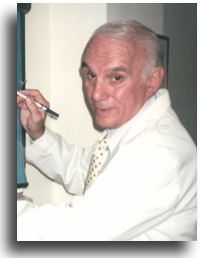 Dr. John O.A. Pagano is a chiropractic physician who has been
treating psoriatics with an “all natural” regimen for forty years. His
book, HEALING PSORIASIS: The Natural Alternative was originally
published in 1991 and has been on best seller lists from 1998 through the
present. He and his regimen are known throughout the world, and for every
conventionalist who disparages the Pagano approach, there is a supporter
who proclaims it unabashedly.
Dr. John O.A. Pagano is a chiropractic physician who has been
treating psoriatics with an “all natural” regimen for forty years. His
book, HEALING PSORIASIS: The Natural Alternative was originally
published in 1991 and has been on best seller lists from 1998 through the
present. He and his regimen are known throughout the world, and for every
conventionalist who disparages the Pagano approach, there is a supporter
who proclaims it unabashedly. Pagano:
 It
all boils down to this: If you have a theory to go on, and there is no
apparent harm to the patient, then go for it. Observe and document the
results, then turn it over to the research scientists (if they are
interested) and let them come up with an explanation. In the meantime,
It
all boils down to this: If you have a theory to go on, and there is no
apparent harm to the patient, then go for it. Observe and document the
results, then turn it over to the research scientists (if they are
interested) and let them come up with an explanation. In the meantime,
 It
should be extremely encouraging however to know that
It
should be extremely encouraging however to know that
 I
say that diet plays a most significant role in the management,
alleviation, and control of the disease. The
difference is,
I
say that diet plays a most significant role in the management,
alleviation, and control of the disease. The
difference is,
 Many people, especially
scientists, want figures and percentages before they commit themselves to
any new idea. OK! Here's one for you:
Many people, especially
scientists, want figures and percentages before they commit themselves to
any new idea. OK! Here's one for you: